
by Jocelyn Elleby, Strategic Advocacy Lead at GS-SABR
Every June, our transport infrastructure is redrawn in a vibrant wave of seasonal solidarity. Bus liveries are plastered with rainbow vinyls, corporate logos follow suit, and across the industry, we celebrate the visibility and inclusion of LGBTQ+ people.
That visibility truly is powerful. As a young queer woman, I still struggle to comprehend that the first years of my career have been the antithesis of my expectations; an environment of inclusivity, tolerance, and a distinct lack of judgment.
Yet, travelling as a queer woman exposes a profound paradox between the successes of our sector and the operational reality.
I have never got on a form of public transport with my girlfriend without checking my shoulder. I have never been unaware of my surroundings when holding her hand. I have never felt the comfort of a touch from the person I love, without wondering if someone was watching us.
Since 2019, I have not been able to get on a bus without being viscerally reminded of the London bus attack: the blood-covered lesbian couple who were beaten after refusing to kiss for the entertainment of a group of men.
Passive stereotyping and objectification of queer women quickly pivoted into something terrifying and real that night, an image that continues to ruminate in my mind.
[Content Warning: The following link contains graphic imagery of violence and blood against LGBTQ+ individuals. View the documented photograph of the incident.]
What does fear look like?
We need to speak plainly about fear, even at a time of pride and celebration.
After all, Pride was a riot, a response to brutality and targeting, and despite the joy this time brings, it also serves as a stark reminder of where LGBTQ+ progress really stands today. In 2023, London TravelWatch reported that over two-thirds of LGBTQ+ respondents experienced victimisation on public transport within a single 12-month period. Every year, again and again, too many of us in the community are reminded that our fear is not irrational, but a reality that actively dictates where and how we can move.
The transport sector is doing great work to reduce violence against women and girls: this is not a perspective that takes away from that struggle, but rather amplifies its nuances.
Public transport provides a highly relational space, governed by personal power, gender presentation, and systemic interactions. Almost all women feel fear here, and with good reason. 54% of women aged 18 to 34 have experienced sexual harassment on public transport in the last year, as reported by TfL.
Queer women navigate this space in a nuanced way, navigating not only misogyny but also homophobia: two, interconnected forces of harassment and fear.
Not only am I hyper-vigilant about wearing a skirt that’s ‘too short’ or a top that’s ‘too low cut’ to avoid unwanted male attention, I’m also fearful of looking too masculine next to my partner, looking ‘too gay’, and becoming a target of homophobia.
These are the exhausting mental gymnastics that women have to perform; every trip taken is a process of constant shoulder-checking and tactical calculations – the hidden, exhausting, unpaid labour of travel. Queer women have to do it twice over, and it is grounded in the everyday reality of subtle, anonymous hostility. Slurs whispered from the seat behind, coughed as people disembark, or stares aimed at any sign of affection.
The harsh reality of a society challenged by hatred and divisive rhetoric – as ours currently is – is that it is never just rhetoric, is it?
How do we make progress?
Our sector is not negating these issues out of malice. It is simply responding to what always was a barrier to addressing violence against women and girls – a lack of data.
An overwhelming 84% of victimised LGBTQ+ passengers chose not to report their experience to the police or transit authorities, according to the Suzy Lamplugh Trust. The unsettling reality is that we do not truly know the scale of this problem; we are operating entirely in the dark, trying to solve a crisis masked by a profound reporting void.
Clearly the biggest problem is the behaviour of aggressors, but we also need to acknowledge an inefficiency with reporting mechanisms. This is something we can change much more easily than a deep-seated culture of homophobia, but it requires more proactive cross-industry collaboration and innovation. As we look towards information systems that can detect aggressive or violent behaviours before escalation, it’s important to ponder the reality behind the statistics we currently possess, and the urgency we’d have if this were understood.
But back to Pride
All of this is precisely why we must robustly defend Pride against cynical accusations of ‘performative rainbow washing’. Symbols carry profound psychological and cognitive weight for queer passengers.
Purposeful initiatives like Transport for London’s fully operational Every Story Matters wrapped bus have been very intentionally deployed on the 63-bus due to disproportionately high rates of hate crimes on that route. The public is forced to confront a visible celebration of diversity, and just maybe if they later encounter that diversity in real life, perhaps see a gay couple holding hands, there is a buffer of acceptance and understanding that has already been built up.
For that queer couple navigating a baseline state of hyper-vigilance, visibility does not entirely remove our fear, and we can’t expect it to be a silver bullet, but it does remind us that the operator is looking out for people ‘like me’ – and they are so committed to that solidarity, in fact, that they want it plastered on a double-decker all year round.
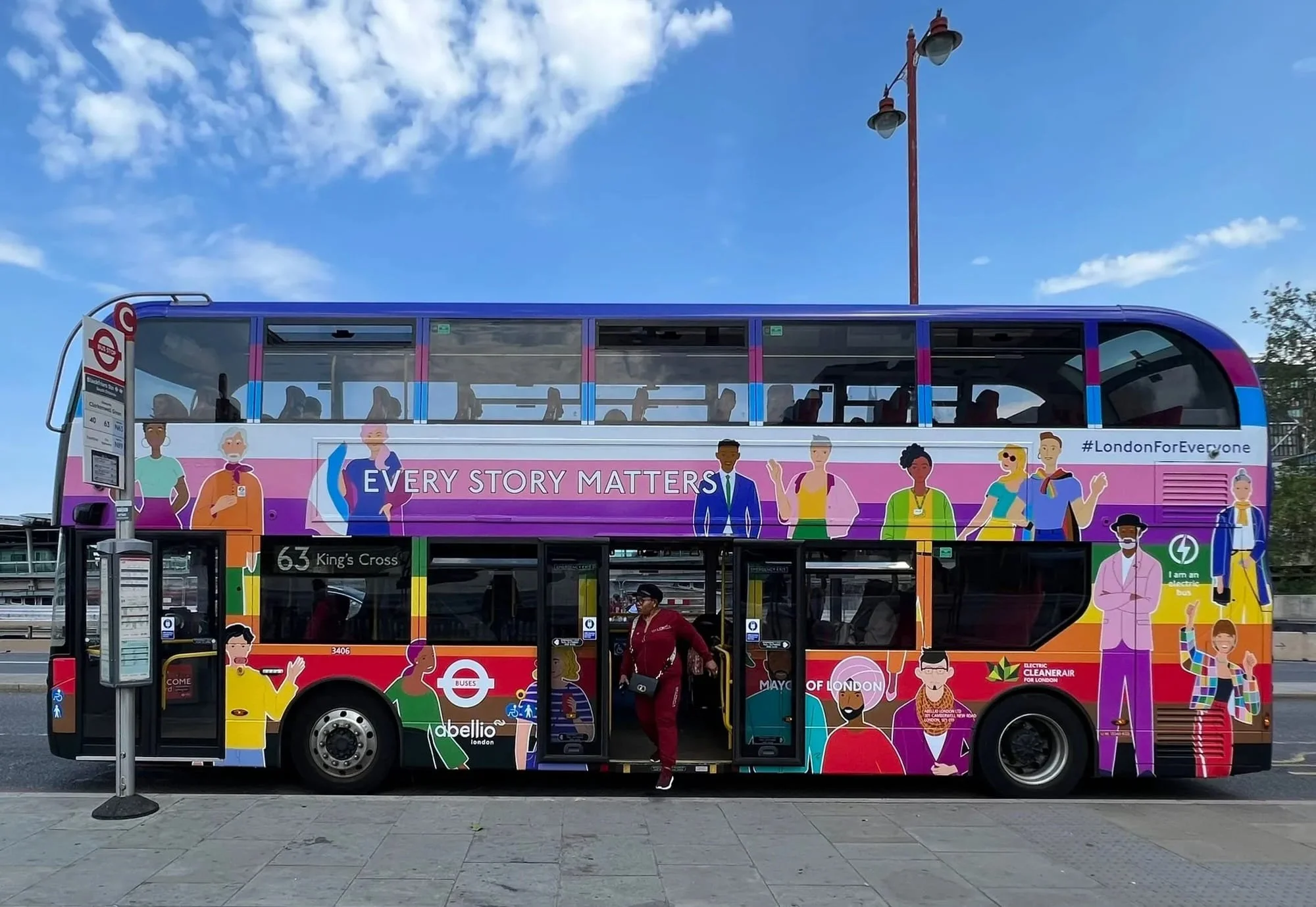
Source: Transport for London
Ultimately, visibility needs to be anchored by a structural and individualised backbone. If we are the flag, we need you to be the pole. We need to challenge sector professionals and corporate operators across the network to move past transient, seasonal Pride celebrations and embrace a deeper kind of allyship that demands something of us all.
True allyship means standing up to hatred in the exact moments in which it counts, so that when we look for help, we aren’t met with passivity, but urgency and care, by people and the organisations in which they work.
To turn that flag into a shield, we need to dismantle the infrastructures that allow vulnerability to breed; we need data shared, trauma-informed frontline staff training, discreet digital reporting tools, and physical vehicle designs that eliminate the isolated corners where aggression can hide.
Of course, the reality today is that sometimes we aren’t able to put a flag up at all. When local councils are actively banning the flying of Pride flags, we need more than ever to show our dissent. Let us proudly pin progress Pride flags to our jackets, plaster our identity on the sides of double-deckers, but also commit to the heavy lifting required to protect the people inside them.
In a climate where we still live in fear, please do whatever you can to ease the burdens queer people are carrying.
My sincere thanks to Alison Camps, Claire Alleguen, Polly Shute, and Susannah Walker, whose invaluable insights, guidance, and shared dedication helped shape this piece.