
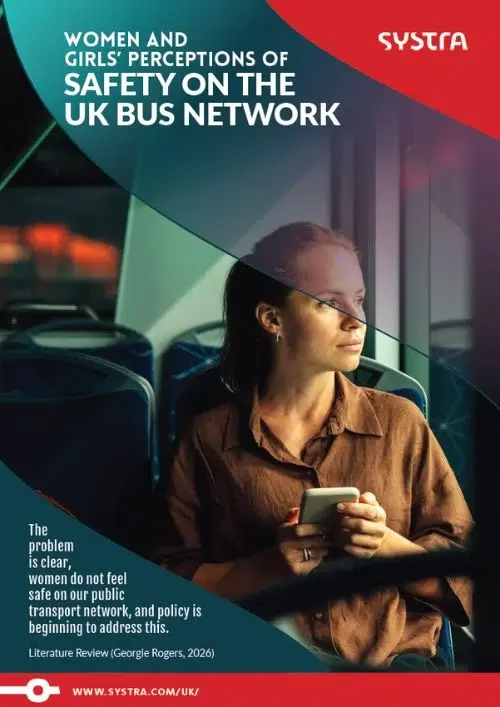
A summary of SYSTRA’s 2026 literature review, Women and Girls’ Perceptions of Safety on the UK Bus Network, as part of the Women in Transport women’s safety working group.
The problem is not in dispute. Across the UK bus network, women and girls do not feel safe – and a growing body of research now tells us, in detail, what “feeling safe” actually depends on.
SYSTRA’s recent literature review, authored by Georgie Rogers, pulls that evidence together in one place. For anyone in our sector working on this issue, it is a useful map of both the scale of the problem and the levers we have to address it.
Here are the review findings we think matter the most.
The gap is wide, and it gets wider after dark
The headline disparity is stark: 48% of women report feeling unsafe when travelling alone after dark, compared with 19% of men. During the day, the figure for women sits at around 11%, but it rises sharply at night: 63% of women avoid evening travel altogether, many of them changing how they behave in order to feel safe.
For younger passengers, the picture is just as concerning. A 2025 Girlguiding survey found that 31% of girls and young women avoid taking public transport on their own, and 86% avoid going out after dark, because of safety fears. This is not a marginal inconvenience; it is a large group of people rationing their access to the network.
Safety is about the whole journey, not one feature
One of the SYSTRA review’s most important points is that perceptions of safety are shaped less by any single feature than by the whole journey. That means the walk to the stop, the wait at the shelter, conditions on board, and the interchange all count. Crucially, women associate safety with:
Travelling free from harassment
Having their personal space respected
Being able to see visible staff who can help
Good lighting
A reliable journey that does not leave them stranded.
Asked directly what safety means to them, women describe the freedom to travel without being "on guard", confidence the journey will be harassment-free, clear standards of behaviour across the network, and enough space to move away from others. CCTV helps – but only if people believe someone is actually monitoring it and will respond.
Importantly, the evidence shows that real and perceived risk carry equal weight in shaping travel choices, so incident reduction alone is not enough. Confidence has to be built, too.
The built environment sends a signal
Environmental conditions do a lot of the work. Transport Focus’s 2025 shelter research found that 58% of frequent bus users are satisfied with the safety of their local shelter, but that drops to 50% after dark – and to just 44% among women. Dim or broken lighting affects how safe 85% of passengers feel, and damaged shelter walls or seating affect 82%. Around 60% think CCTV and a help button would help.
Disrepair matters more than it looks. Graffiti, broken glass, damaged seats and unreadable timetables are not just cosmetic – passengers read them as signs of neglect, and that in turn erodes their sense of safety.
Reliability plays a similar role here: uncertainty stretches out waiting time and makes journeys feel less controllable, which heightens feelings of isolation and vulnerability, especially after dark or in rural areas.
Women’s safety on board, around the world
The review is clear that this is not a UK-only story. Reported experience of sexual harassment on public transport reaches 87% of women in France, 75% in Japan, 90% in Pakistan and 84% in Colombia.
Closer to home, research for the Department for Transport found that 28% of public transport users had experienced unwanted sexual harassment, with young women particularly affected by staring, invasion of personal space and harassment. This occurred most often on buses and trains, and was most likely to happen during weekday mornings, suggesting a link to busy commuting times. Crowding is part of the problem, as it lets unwanted contact be passed off as accidental and removes people’s ability to move away.
Policy and industry are starting to respond
Encouragingly, the review shows momentum building. The Bus Services Act 2025 makes violence against women and girls (VAWG) training for drivers and staff mandatory rather than optional, requiring them to recognise and respond to incidents. In March 2026, the Confederation of Passenger Transport launched a national Driver CPC training module on tackling VAWG, built around the "Four Ds" bystander framework: distract, direct, delegate and document.
Operators are moving as well:
First Bus has partnered with the volunteer phone service Strut Safe and holds White Ribbon accreditation
TfL’s October 2025 "act like a friend" campaign encourages bystanders to look out for one another
Stagecoach East has worked with Cambridge Rape Crisis Centre on what is described as the sector’s largest VAWG prevention initiative.
What good looks like, and where Women in Transport comes in
The SYSTRA review closes with a practical set of considerations for local authorities and operators: good lighting at stops and on board, natural surveillance from surrounding buildings and transparent shelters, well-maintained and clean infrastructure, accessible seating, clear and reliable real-time information, believable reporting routes, and visible, trained staff.
The most consistent theme across all the evidence is a simple one. What makes women and girls feel safer is not only protection after something has gone wrong, but a network that shows, in advance, that someone is paying attention.
None of this changes on its own. The value of a review like this is that it turns a widely felt problem into specific, ownable actions – and our members and corporate partners are unusually well placed to take them.
Whether you influence stop location, procurement, lighting standards, staff training, reporting systems or the design of the next fleet, there is a line in this evidence with your name on it.
Our Women’s Safety working group’s ask is straightforward: use the report as a checklist against your own network. Where are the dark stops? Where is the reporting route no one believes in? Where does disrepair signal that no one is watching? The strength of Women in Transport has always been that its members sit inside the organisations that make these decisions – which means we are not just describing the problem, we are positioned to fix it.
The full report is available from the SYSTRA website. Or you can visit our Women’s Safety page to see how you can get involved in the working group.