
Written by Tanya Fosdick, Chief Operating Officer at Agilysis
“When you don’t discriminate, you talk about men.” That line from Manuelle Salathé, Head of the French Road Safety Observatory, has stayed with me since a conference in 2025 when we both presented on inequalities in road safety data.
The headline is well-known: men are 2.23 times more likely than women to be killed or seriously injured (KSI) on Britain’s roads (STATS19, 2020–2024). So, road safety has, understandably, focused on young men, speed and risk-taking. But when we analyse all casualties together, men’s over-representation sets the agenda, and the different needs of women disappear from view. When I split the data by sex, age, mode and exposure, a different picture emerges.
What the data shows
Exposure explains some of the gap, but not all of it. Women walk further and travel far more miles as car passengers than men. Even so, men have higher KSI rates per mile travelled in every mode. That supports the focus on male risk, but only on average.
Older women drivers face rising risk. For every mile driven, women aged 70 and over are killed or seriously injured at around twice the rate of men the same age. KSIs among female drivers aged 65+ rose from 419 in 2005 to 725 in 2024. Over the same period, numbers for older female passengers and pedestrians stayed broadly flat. Part of this is that more older women now drive: licence holding among women aged 60–69 has risen from 15% in 1975 to 80% today. But mileage alone does not explain the increase. Older female drivers are also more often involved in crashes when turning right and at junctions.
Women passengers are usually hurt in cars driven by men. Nearly three in four women killed or seriously injured as car passengers were travelling with a male driver.
Women’s bodies are injured differently. Women in cars are more likely to suffer broken necks and fractured legs, while men are more likely to be killed or suffer deep cuts. Trauma research on 70,027 UK patients (Nutbeam et al., 2022) found women were more often trapped in the vehicle and had more pelvic and spinal injuries. This is despite women being more likely to wear a seatbelt. There are two reasons for this: women tend to drive smaller cars with less effective safety systems. Mandatory crash tests also still use a scaled-down male dummy to represent women, and whiplash protection has been found to work significantly better for men as a result.
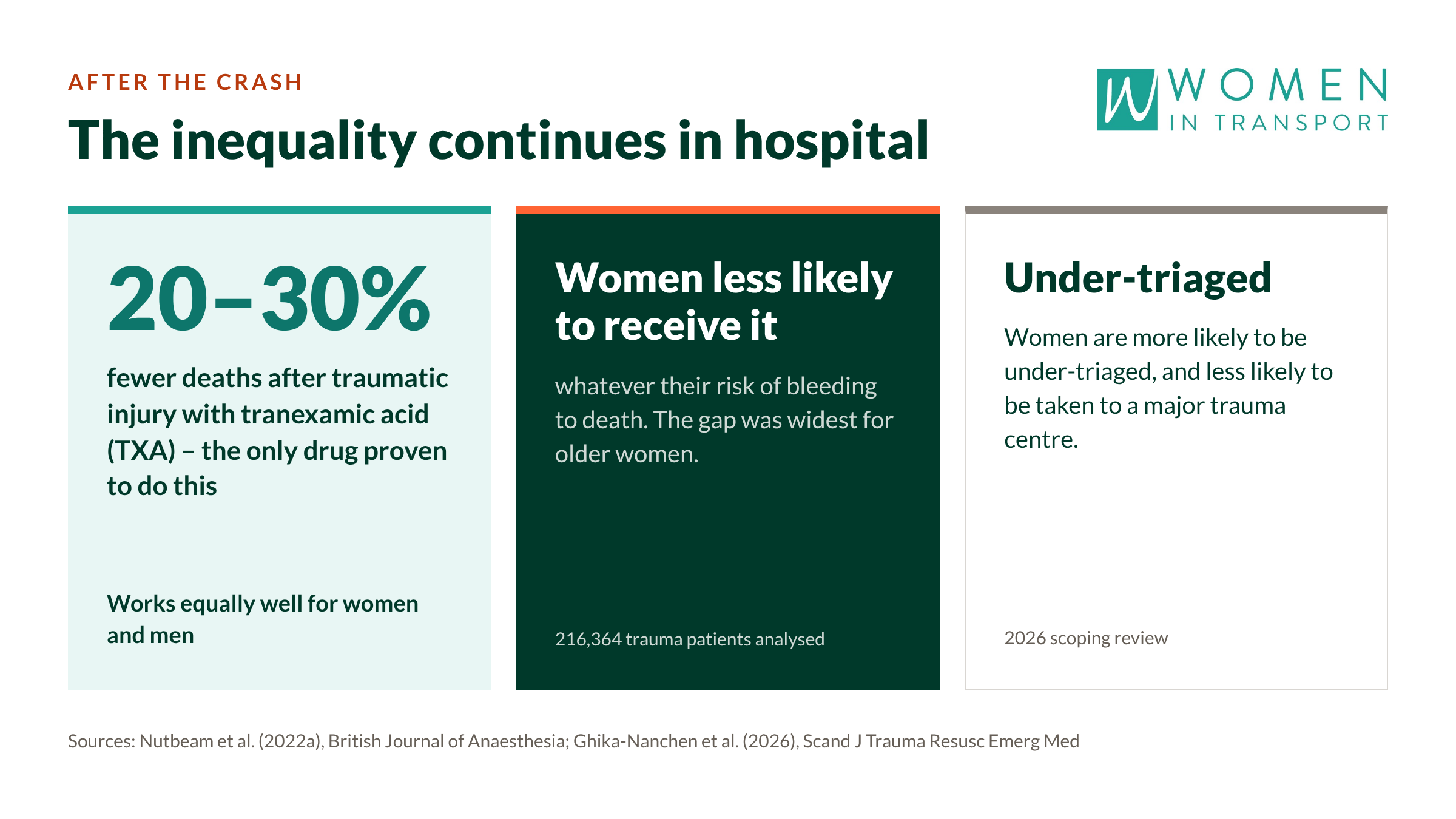
The inequality continues after the crash. Tranexamic acid (TXA) is the only drug proven to reduce deaths after traumatic injury, cutting them by 20–30%. It works equally well for women and men. Yet analysis of 216,364 trauma patients found women were less likely to receive it, whatever their risk of bleeding to death (Nutbeam et al., 2022a). The gap was widest for older women. A 2026 scoping review also found women are more likely to be under-triaged and less likely to be taken to a major trauma centre (Ghika-Nanchen A, et al. (2026).
What this means for women’s safety
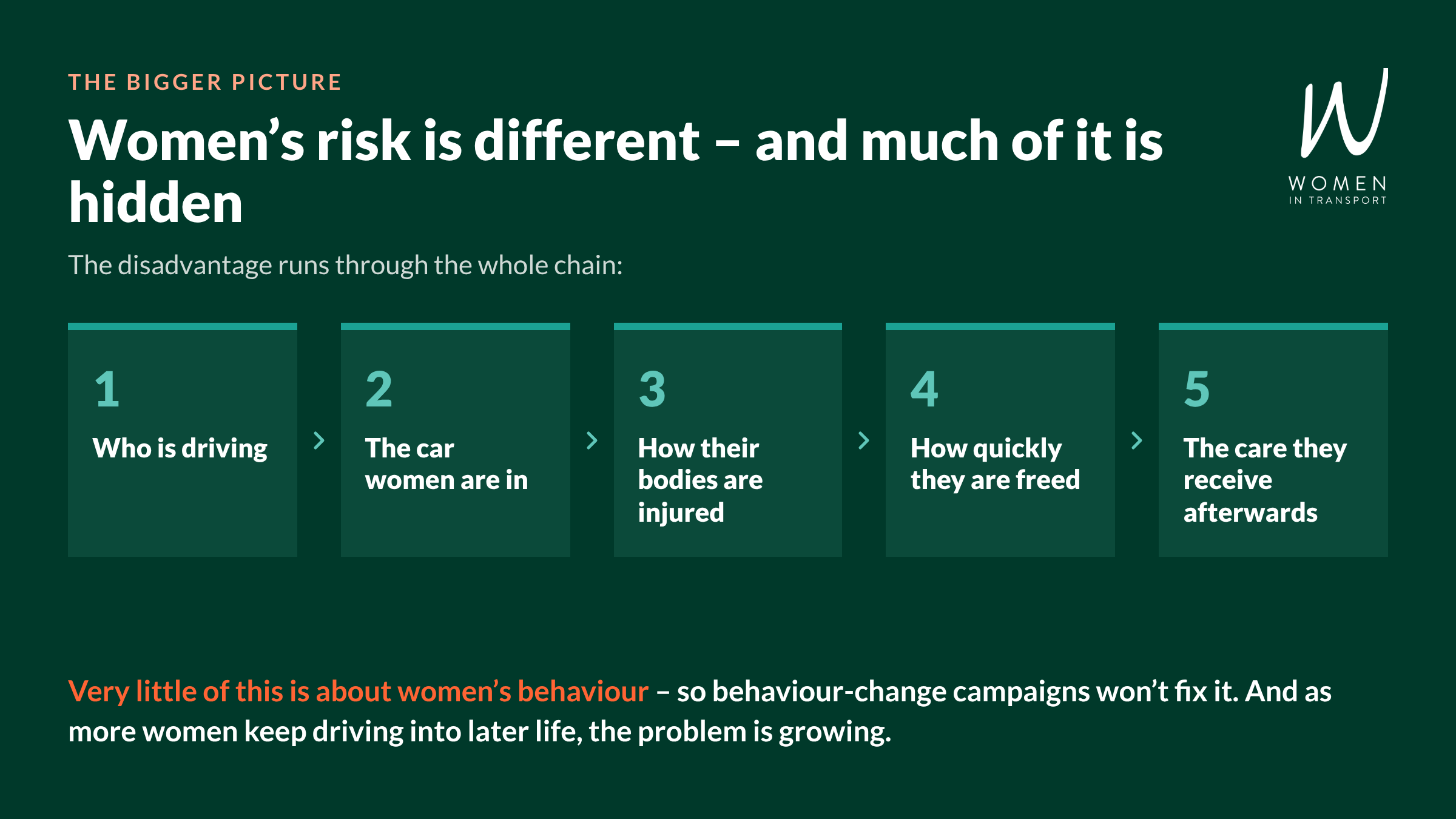
Women’s risk is not simply lower. It is different, and much of it is hidden. The disadvantage runs through the whole chain: who is driving, the car women are in, how their bodies are injured, how quickly they are freed, and the care they receive afterwards.
Very little of this is about women’s behaviour, so campaigns aimed at changing behaviour will not fix it. The problem is also growing. As more women keep driving into later life, the number of older women at risk on our roads will keep rising unless we act.
What we can do
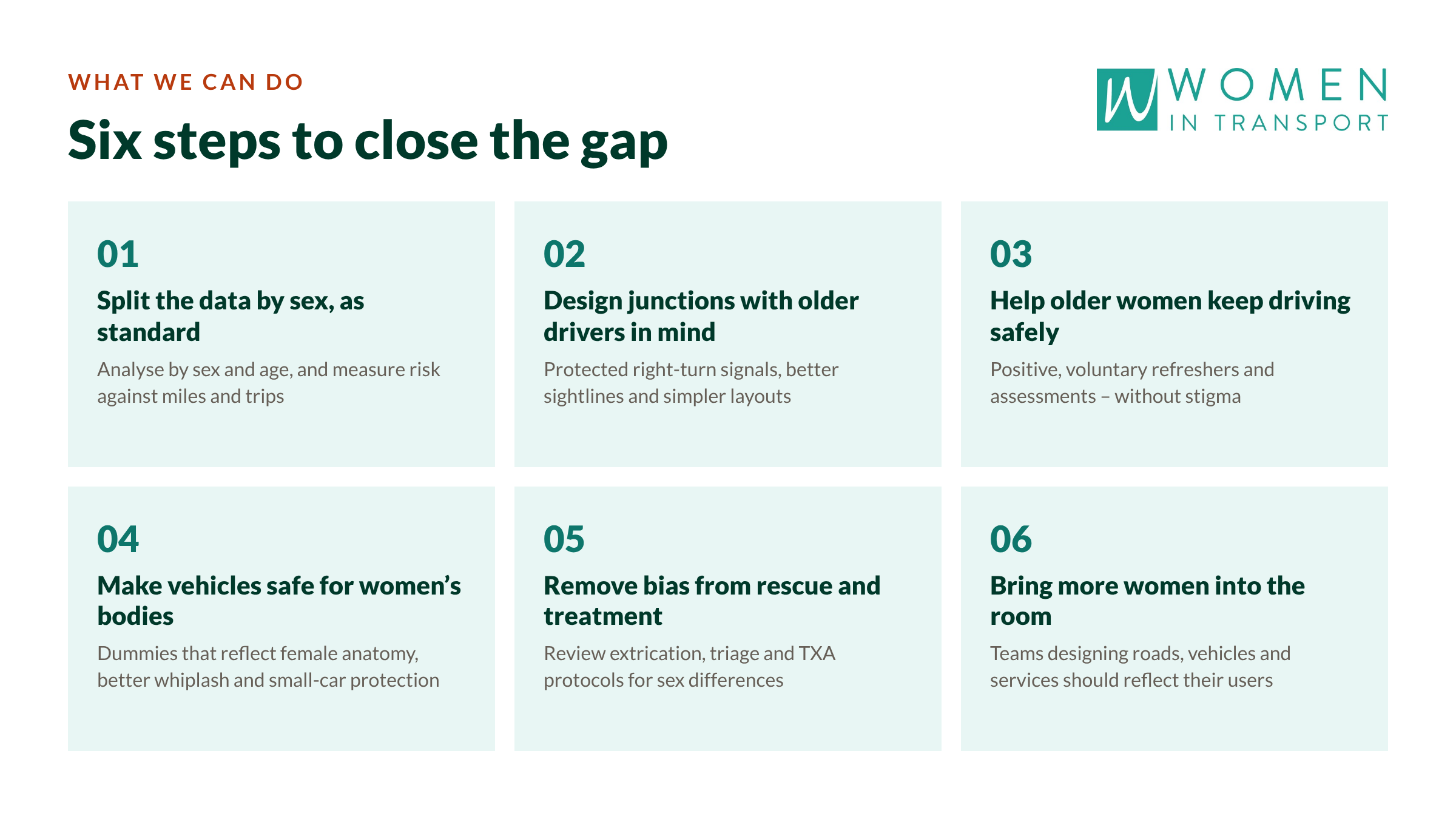
Split the data by sex, as standard. Analyse casualties by sex and age, and measure risk against exposure (miles and trips), not just casualty numbers. If we don’t look, we won’t see it.
Design junctions with older drivers in mind. Right turns and junctions are where older women are most at risk. Protected right-turn signals; better sightlines; and simpler layouts help every driver, especially older drivers.
Help older women keep driving safely. Driving keeps people independent. Offer positive, voluntary support, such as refresher sessions and driving assessments, that helps older drivers stay mobile without being stigmatised.
Make vehicles safe for women’s bodies. Push for crash testing with dummies that reflect female anatomy; whiplash protection that works for women; and better protection in smaller cars.
Remove bias from rescue and treatment. Freeing people from vehicles, triage, and TXA protocols should be reviewed for sex differences, especially for older women and pelvic and spinal injuries.
Bring more women into the room. Diverse teams ask different questions of the data. The people who design roads, vehicles, and services should reflect the people who use them.
Looking beyond the average
Reducing risk for young men will rightly stay central to road safety. But a system designed around the “average” road user, who is usually male, is failing women at several points. Women in Transport members work across planning, engineering, vehicles, operations and policy. Every one of those roles can ask the same question: does this work for women too?
Sources
STATS19 police-reported collision data, Great Britain (2019–2024); DfT National Travel Survey and driving licence data
Nutbeam T, et al. (2022). Sex-disaggregated analysis of the injury patterns, outcome data and trapped status of major trauma patients injured in motor vehicle collisions. BMJ Open, 12:e061076
Nutbeam T, et al. (2022a). Use of tranexamic acid in major trauma: a sex-disaggregated analysis. British Journal of Anaesthesia, 129(2), 191–199
Ghika-Nanchen A, et al. (2026). Sex and gender bias in major trauma care: a scoping review. Scand J Trauma Resusc Emerg Med, 34, 84