
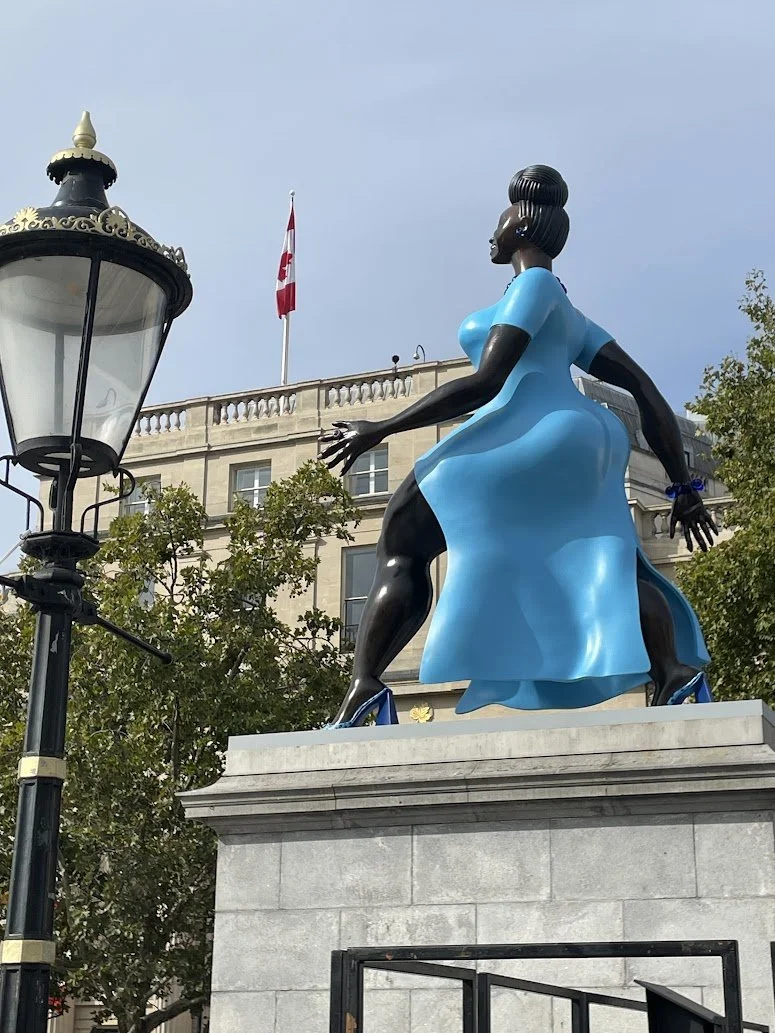
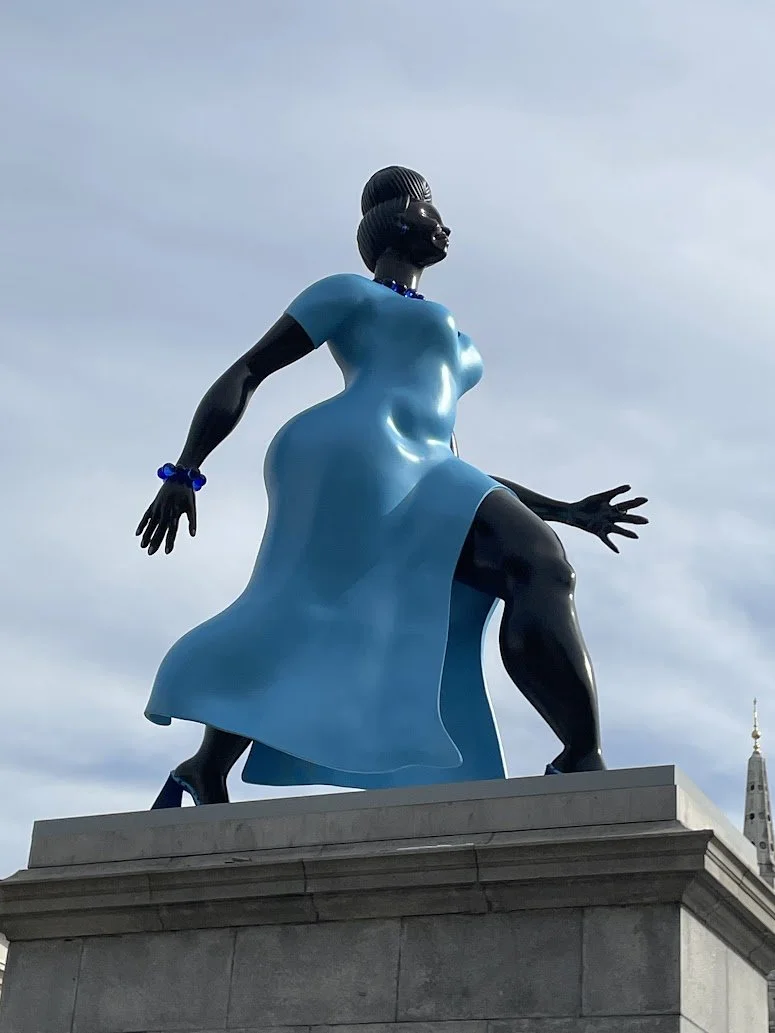
On 10th September 2026, Trafalgar Square welcomed a new figure. Among the admirals, generals and Landseer's lions now stands a young Black woman in a vivid blue dress, heels and beaded jewellery, caught mid-stride as she makes her way through the city.
Lady in Blue, by New York-based artist Tschabalala Self, is the 16th artwork to occupy Trafalgar Square's Fourth Plinth. She will stand there for the next two years, and she is already one of the most talked-about public sculptures in the country.
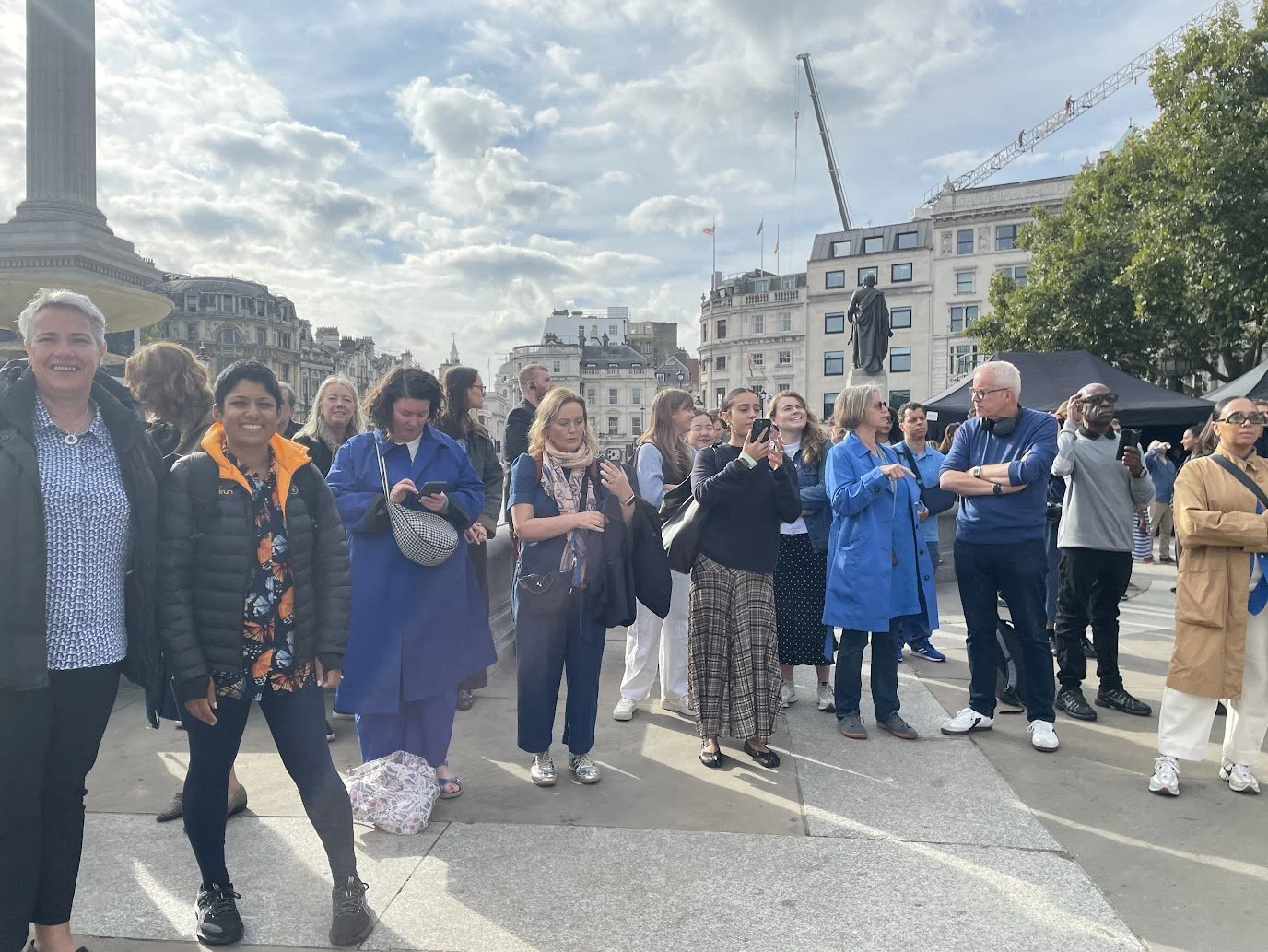
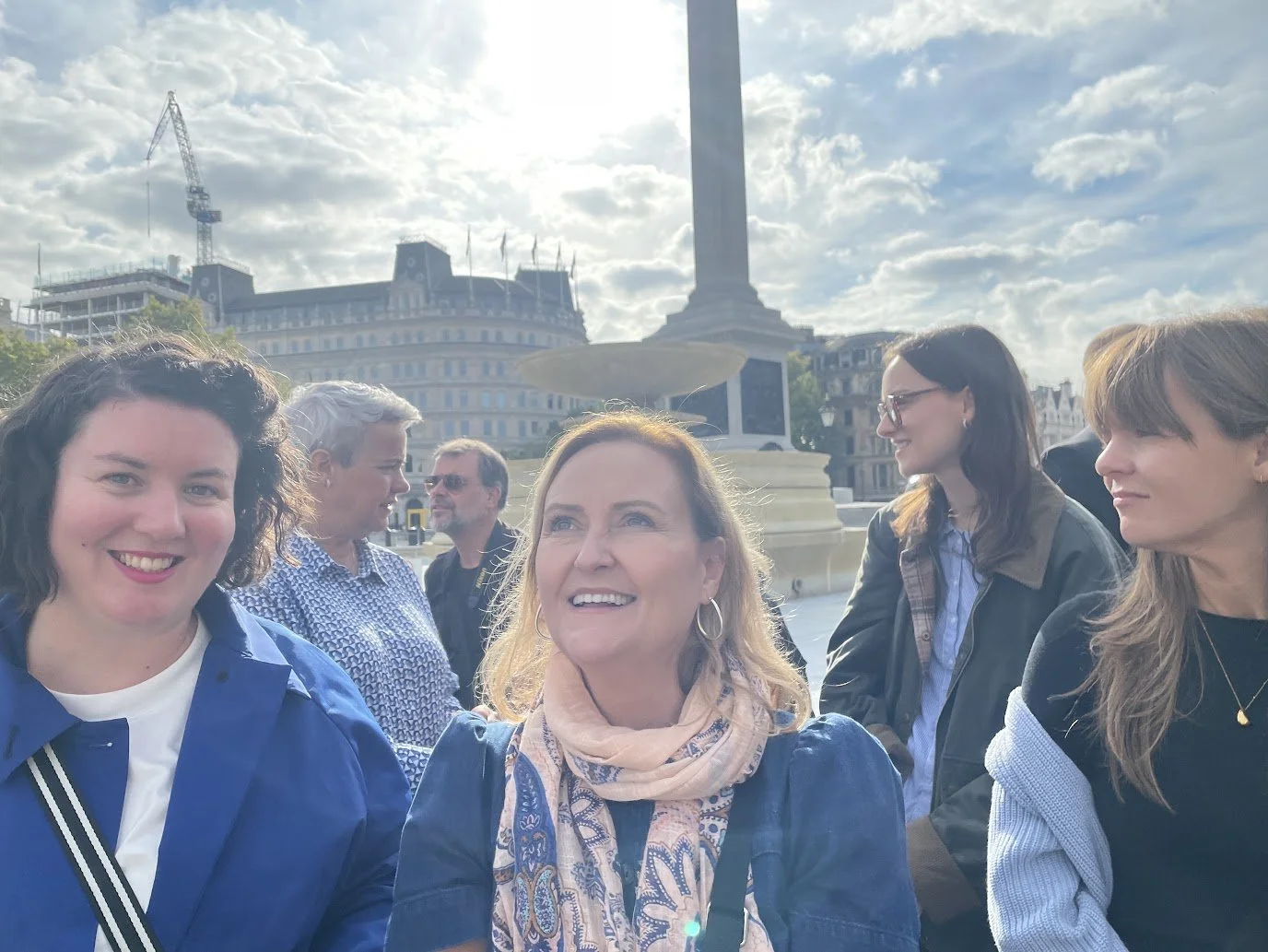
Women in Transport were there for the statue’s public unveiling.
Women in Transport at the unveiling
Our CEO, Sonya Byers OBE, was at Trafalgar Square along with a group of Women in Transport members:
“I was moved and inspired to join our new Joint Lead for London and the South East, Claire Alleguen, and 20 of our members for the unveiling of the beautiful Lady in Blue sculpture in Trafalgar Square. In a time when diversity and representation matter more than ever, it is wonderful to see a tribute and recognition of everyday women on one of the world's most significant platforms for public sculpture. If you haven't seen the statue yet, I encourage you to visit in person. It is truly an inspirational and uplifting sight and a reminder to all women to stand tall and be proud of our contributions. We matter. Representation matters. As Justine Simons OBE stated in her opening remarks, in London, our diversity is our greatest asset. It's our superpower.”
Women in Transport events are an opportunity for our members to connect regardless of their region, and we were delighted to see a London-based mentor on our Advance programme meet her Edinburgh-based mentee in person at the unveiling.
Who gets a statue?
Public monuments tell us who a city chooses to honour. In London, the answer has overwhelmingly been men – and mostly white men of military or political rank. Of the roughly 1,500 statues across the capital, only a handful depict women of colour.
Tschabalala Self set out to challenge that narrative directly. Rather than a monarch or a war hero, her figure is an anonymous, contemporary Londoner – the kind of woman you might pass on the way to Charing Cross or queue behind for the number 24 bus. In the artist's own words, she is "not an idol to venerate or a historic figure to commemorate”.
The artist’s choice resonates with us at Women in Transport. So much of our work asks the same question Self is asking in bronze: who are our public spaces designed for, and who is made to feel like they belong there?
Streets, stations, platforms and squares shape how freely women move through the world. A monumental woman walking confidently through the heart of London, with ambition and purpose, is a powerful image of what that freedom can look like.
As Self put it at the unveiling: she wants people to leave feeling they can “exist as they are without explanation”.
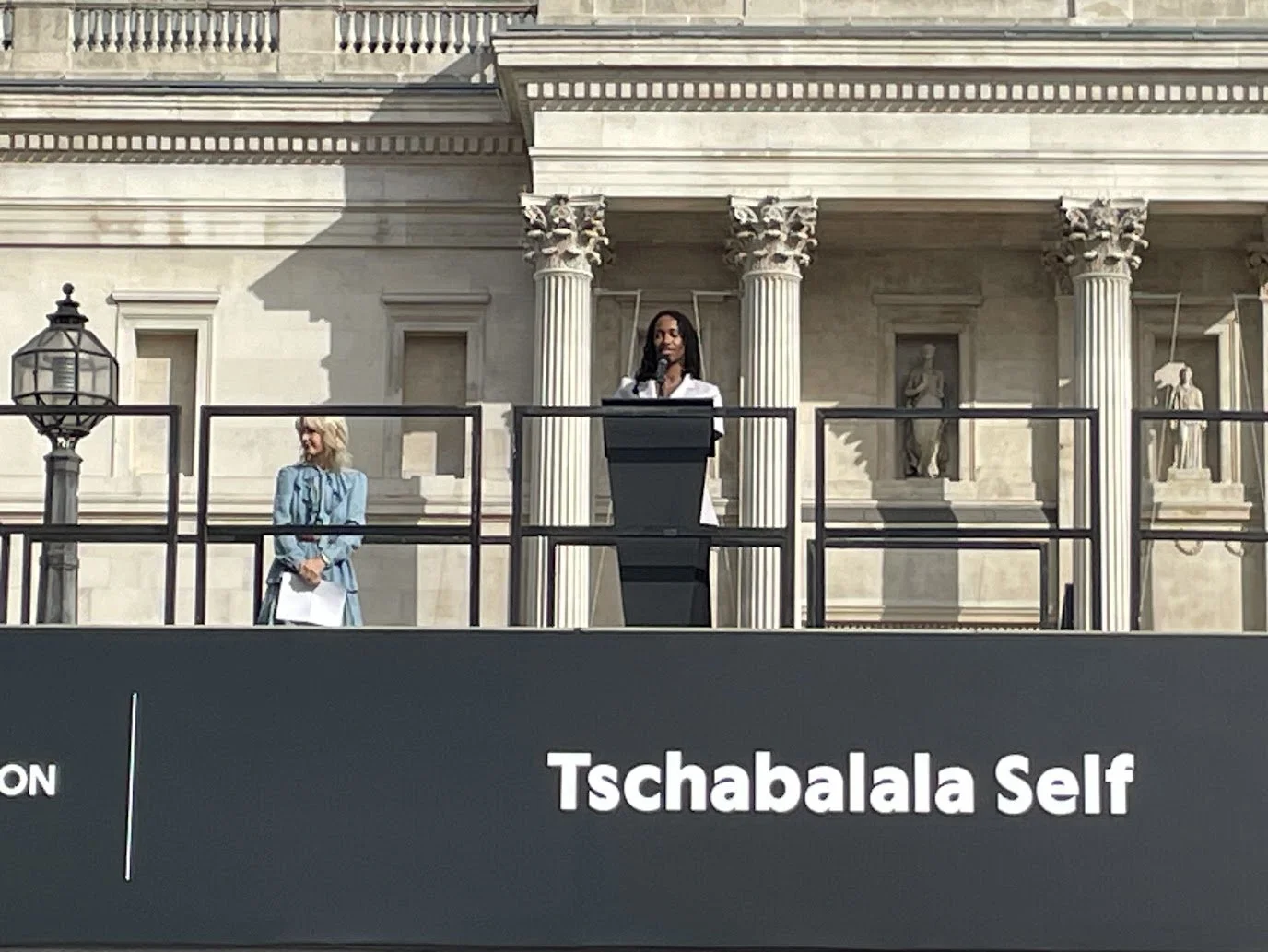
Tschabalala Self at the unveiling, joined by Justine Simons OBE, London's Deputy Mayor for Culture and the Creative Industries.
The woman behind the work
Tschabalala Self was born in Harlem, New York, in 1990. She studied at Bard College before completing an MFA at the Yale School of Art, and has since built an international reputation for her depictions of Black women across painting, printmaking, fabric, collage and sculpture. Her work explores the intersections where race, gender and sexuality meet, and how the Black female body is seen (and too often misread) in public life.
Lady in Blue is her largest sculpture to date, and her first public work in the UK since 2023, when her sculpture Seated in Bexhill-on-Sea was vandalised, with the figure's skin spray-painted white. The response from the local community was striking: hundreds of volunteers came together to clean and restore the work. Self has described the experience as upsetting but ultimately edifying, and how it reinforced her belief in the role public art can play in bringing people together.
To hear more from the artist herself, you can listen to Tschabalala Self on BBC Radio 4's Woman's Hour.
The Lady’s journey to the plinth
The Fourth Plinth itself has an unusual history. Built in 1841 for an equestrian statue that was never completed, it stood empty for more than 150 years. In 1998, the Royal Society of Arts launched a programme to fill it with contemporary art. Today the commission is funded by the Mayor of London, with support from Arts Council England and Bloomberg Philanthropies, and a new work is installed every two years.
Self's route to the plinth began in February 2024, when she was named on a shortlist of seven artists alongside Chila Kumari Singh Burman, Gabriel Chaile, Ruth Ewan, Thomas J Price, Veronica Ryan and Andra Ursuţa. Models of all seven proposals went on display at the National Gallery, and the public was invited to have its say: more than 10,000 votes were cast.
In March 2024, the Fourth Plinth Commissioning Group, chaired by writer and curator Ekow Eshun, announced Lady in Blue as the 2026 commission, with Ursuţa's shrouded equestrian figure to follow in 2028.
Two and a half years later, the finished figure has arrived: cast in bronze and finished with a colour inspired by lapis lazuli, the semi-precious stone ground into pigment since antiquity, and the same rich blue found in many of the paintings in the National Gallery just behind her.
Lady in Blue replaces Teresa Margolles's work made from casts of the faces of trans people, continuing a run of recent commissions that have used this most prominent of sites to widen the picture of who is seen in public life. Self also joins a small but growing group of women artists to have taken the plinth, including Rachel Whiteread in 2001 and Heather Phillipson in 2020. When her London residency ends, Lady in Blue will move to a permanent home in Fornebu, Norway.
Go and see her
Lady in Blue is a centrepiece of London Sculpture Week, running from 19th to 27th September. If your travels take you through Trafalgar Square, take Sonya's advice and stop to see her in person and see a woman standing (very) tall.
Advance mentoring: looking ahead to 2027
This month marks the end of the Advance 2026 mentoring programme, and the feedback from our mentees and mentors has been overwhelmingly positive.
Applications for Advance 2027 – the 10th year of the programme – will be opening soon, so keep a look out for more details.