
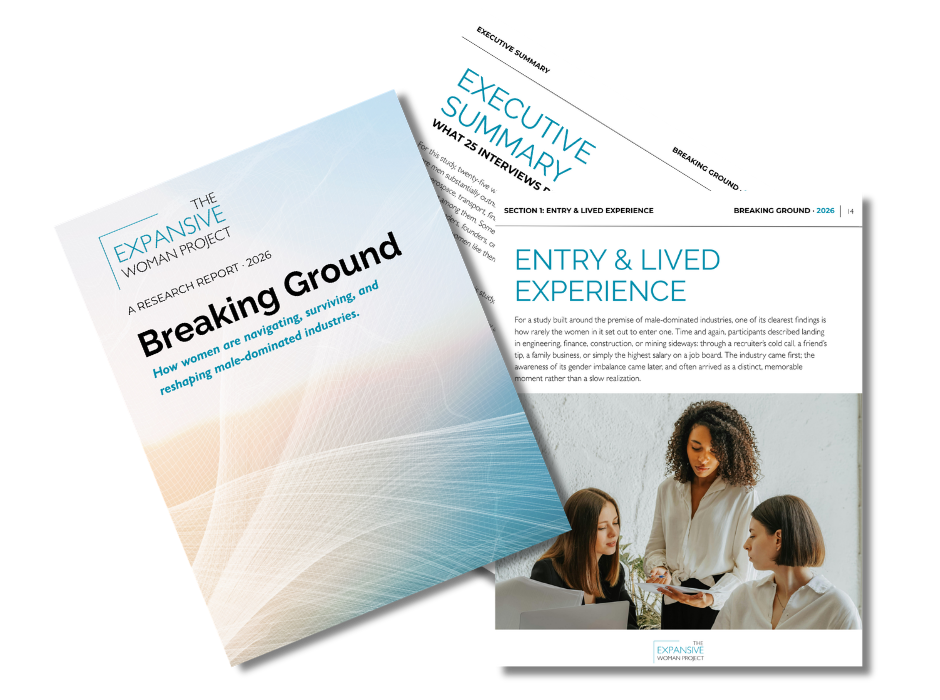
Women in Transport CEO Sonya Byers OBE is one of 25 senior women interviewed for Breaking Ground, a new report from The Expansive Woman Project. It brings together candid conversations with women working in industries that build, power, fund and move the world – and transport is right there in the mix.
Earlier this year, Sonya gave researcher Shantel Tse an hour of her time and a great deal of honesty. Their conversation now sits alongside interviews with women across 21 industries and five countries and regions: Canada, the US, the UK, Ireland and the EU.
The women in the report have mostly never met. But they describe their working lives in remarkably similar language – and anyone who has worked in transport will recognise a lot of what they have to say.
About the report
Breaking Ground was produced by The Expansive Woman Project, a free community and training organisation founded by leadership coach and former tech CEO Judy Sims. Shantel Tse, who sits on the project's Board of Advisors, led the research and conducted every interview.
The idea grew out of Judy's work with a group of women in the US waste management sector. They were capable, highly committed, and stuck – passed over for senior roles, often the only woman in the room, and handed unhelpful advice like "just be more confident". Before building anything bigger, the team wanted to know whether those experiences were the exception or the evidence of a pattern.
The answer, across all 25 interviews, was clear. Four patterns came up again and again:
Women arrive by accident more often than by design, and only later realise how male-dominated their environment is.
Credibility comes with a "legitimacy tax" – extra time, evidence and performance needed to be taken at face value.
Sponsorship moves careers forward, but it's scarce. Mentors give advice; sponsors put your name forward when you're not in the room.
Women's networks make the rest survivable – and most were built by women themselves, because nothing existed before them.
To protect participants who asked for anonymity, the report attributes every quote by industry and seniority only.
The transport picture
The report draws a sharp distinction between two kinds of problem. Some industries struggle to get women through the door at all. Transport has the opposite problem: it recruits women in real numbers and then loses them on the way up. According to McKinsey and LeanIn.Org data cited in the report, women make up 55% of entry-level roles in transportation but just 18% of the C-suite. That drop-off is the gap Women in Transport exists to close.
The report also cites research suggesting that roughly 70% of women surveyed in the transport sector have personally experienced sexual harassment or discriminatory behaviour at some point in their careers.
Sonya's interview runs through several sections of the report, from early-career experiences to what actually helps women progress.
On the culture many women have walked into:
“For people at your desk looking at page-3 models… and making sexist remarks, talking about the appearance of women. And women being overlooked for progression, with men just being promoted more quickly within the organisation.”
On the motherhood penalty – which, Sonya points out, applies whether or not a woman ever has children:
“There is a motherhood penalty. Regardless of whether you want to have a child or not, and even if you're capable of having one or not, you are held back by virtue of being a woman, and the idea that you might want to have a child at some point. There are still a lot of transport companies that do not have a parental leave policy at all, because you might be the first to bring it into that organisation.”
On how small, practical systems can quietly push women out:
“It still happens, in some organisations, that when you go on maternity leave they delete your whole email account, because if an account has been inactive for a year it gets deleted. Then you're coming back in and starting from scratch.”
Build your network before you need it
Of all the advice in the report, this was the most repeated – and Sonya puts it plainly:
“You have to be purposeful about building network. I find women who make the mistake of putting their head down, thinking that will get them noticed. The problem comes when something changes – a merger, a budget cut – and suddenly they're out of a job and they don't have a network to fall back on.”
Sonya is equally clear about what kind of network helps. Comedy nights and drinks-based events, often with a cost attached, don't work for everyone:
“What worked was something with a technical, professional development element to it.”
The report's findings back this up. The most effective women's organisations combine structured, skills-based content with relationships across career stages. Purely social, under-resourced groups deliver far less.
Where Women in Transport comes in
The report's conclusion highlights the gaps that still make progress harder than it needs to be: sponsorship, care-giving policy, pay transparency, and recognition of the invisible work women do to keep teams running.
These are the issues our community works on every day. Our Lead, Advance and Grow programmes are built around exactly the mix the report recommends – practical development, mentoring and sponsorship, and a network that's there before you need it.
Leadership representation is a metric that Women in Transport directly tracks in its own research. Our Equity Index, now open to responses for its third year, is the UK’s leading benchmark for gender equity in the transport sector and, to our knowledge, the only one of its kind globally. Between 2023 and 2025, we saw an increase in women in leadership from 26% to 36%; however, a key challenge is that most of those roles remain outside core operational functions, and the transport sector still faces a projected shortfall of between 409,000 and 618,000 workers by 2030 (ONS analysis).
We're proud that Sonya could add a transport perspective to this research, and grateful to Shantel Tse and The Expansive Woman Project for giving these 25 women the space to speak so openly. If something in the report rings true for you, be an ally and pass it on to your leadership team, your colleagues, or the woman one rung below you.
Read the full report
Breaking Ground is free to download. It includes all 25 voices, the wider research behind them, and a set of practical recommendations for women and organisations alike.