• Events
  • Membership
  • Courses
    • Lead
    • Advance
  • Research
  • Programmes
    • Women's Safety
    • Equity Index
    • 20 Years
  • Who we are
    • Blog
    • Podcast
    • Our Regions
    • Leadership Team
    • APPG
    • D&I Bus Group
  • Partner with us
  • Volunteer with us
  • Menu

Women in Transport

  • Events
  • Membership
  • Courses
    • Lead
    • Advance
  • Research
  • Programmes
    • Women's Safety
    • Equity Index
    • 20 Years
  • Who we are
    • Blog
    • Podcast
    • Our Regions
    • Leadership Team
    • APPG
    • D&I Bus Group
  • Partner with us
  • Volunteer with us
 
Get in touch
 

Designing Rail for Everyone: Technical Insights from the Women in Transport Scotland Hub Webinar

May 13, 2026 in Event, Insight

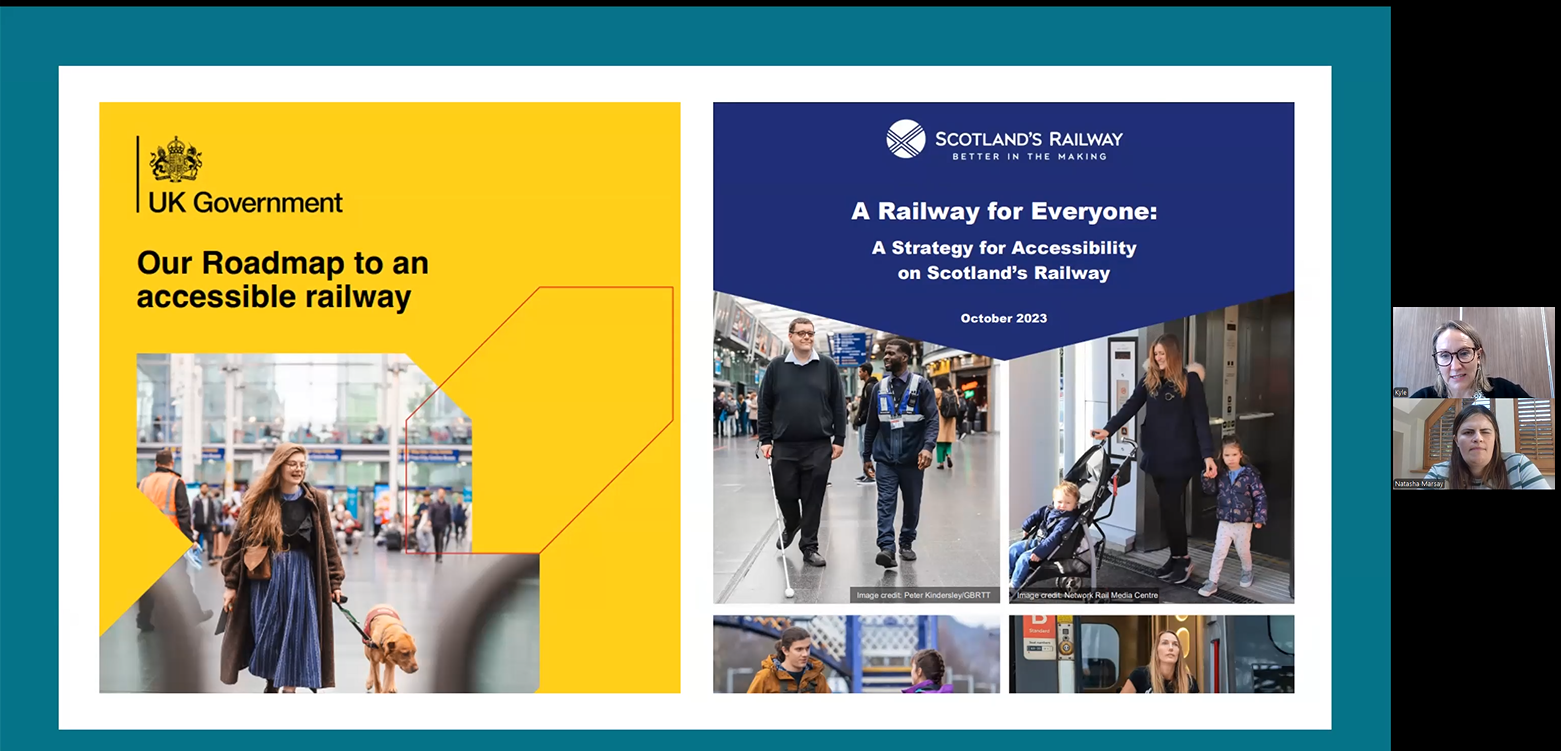
At the recent Women in Transport Scotland Hub technical webinar, members heard from two Network Rail specialists who are reshaping how accessibility is understood, measured and delivered across the rail network. The session moved beyond high‑level principles, offering practical, data‑led insight into what inclusive customer journeys look like in reality – and how small technical details can have network‑wide impact.

Turning accessibility data into actionable insight

Kyle Adams, Passenger and Stations Analysis Manager at Network Rail, opened with a clear message: accessibility is not a single intervention, but a system of interdependent components stretching from journey planning through to boarding and onward travel. His work focuses on translating vast quantities of station‑level data into insights that can inform policy and investment decisions.

A major technical step forward has been the comprehensive national accessibility audit of stations, funded by the Department for Transport. For the first time, the industry now has detailed, consistent data on core measures such as step‑free access, toilet provision, help points and equipment quality across the whole network. This has revealed both progress and significant gaps. For example, while around 57% of stations are fully step‑free to all platforms, far fewer meet modern compliance standards for accessible toilets, even where facilities exist.

Crucially, Kyle emphasised that availability alone is not enough. Fit‑for‑purpose design matters. Narrow doorways, inaccessible control buttons or unsuitable door handles can render otherwise “accessible” facilities unusable. Identifying these details through data allows low‑cost, high‑impact interventions – sometimes as simple as replacing the wrong type of toilet door handle – that materially improve passenger experience.

From infrastructure to lived experience

Natasha Marsay, Accessibility and Inclusion Strategy and Policy Lead at Network Rail, brought the operational perspective, focusing on how accessibility is delivered day‑to‑day at the 20 Network Rail–managed stations, which account for almost a quarter of all rail footfall nationally.

Her insight highlighted the scale and complexity of passenger assistance. In a single year, over 960,000 assisted journeys were delivered at these stations, accounting for roughly a third of all assistance nationally. Importantly, 40% of these were “turn up and go” requests, reinforcing the need to design stations and staffing models that can flex in real time, rather than relying solely on pre‑booking.

Natasha stressed that accessibility is not a standalone function. It relies on coordinated systems involving station teams, control rooms, cleaning staff, security and operators. Training plays a critical role: all frontline colleagues receive mandatory disability equality training aligned to regulatory standards, supplemented by targeted modules such as dementia awareness and autism training. These are designed to build confidence, empathy and practical capability, particularly during disruption.

Innovation, information and independence

The webinar also showcased how technology can support more independent journeys. Innovations include British Sign Language information boards, indoor wayfinding technology for blind and partially sighted passengers, and exploration of new digital alternatives to traditional hearing loops. These tools do not replace staff support, but they give passengers more control and predictability.

Clear, trusted information underpins all of this. Publishing detailed, up‑to‑date accessibility data through National Rail Enquiries enables passengers to plan confidently and make informed choices – including choosing alternative routes when facilities are unavailable.

The session closed with a powerful reminder: inclusive design benefits far more than those with registered disabilities. From people with luggage or prams to those experiencing temporary impairment, accessibility improvements are fundamental to safety, resilience and the future growth of rail.


Annual membership for Women in Transport is £60, providing access to professional development and networking opportunities. Corporate packages are available; for inquiries, please email us or visit our website.

Our partnership packages are a flexible and accessible way to support Women in Transport and your organization's equity, diversity, and inclusion objectives. Learn more about our partnership opportunities here and contact us if you would like a meeting to discuss how we can work together.

Follow us on Linkedin at Women in Transport, and at @transportwmn on Instagram for events, news, and updates.

Tags: Scotland Hub, rail
Prev / Next

News

Women in Transport provides a varied and lively events programme with access to thought leaders, senior stakeholders and professional trainers.

As the Secretariat to the All Party Parliamentary Group for women in transport, we are committed to working with the UK government to increase the representation of women in the transport sector.

Join Women in Transport
 
No results found

Featured Posts

Featured
March 8, 2026
inclusive design, Women in Transport Bus, research, flexible working
Give to Gain in Bus and Coach: Driving Change Together
March 8, 2026
inclusive design, Women in Transport Bus, research, flexible working
March 8, 2026
inclusive design, Women in Transport Bus, research, flexible working
January 19, 2026
Women in Transport Bus, D&I Bus Group
Your Voice Matters: Help Shape the Future for Women in Bus & Coach
January 19, 2026
Women in Transport Bus, D&I Bus Group
January 19, 2026
Women in Transport Bus, D&I Bus Group
November 24, 2025
Inclusion, diversity and inclusion, Intersectionality
Creating Public Transport That Works for Everyone: My reflections from the IMechE Roundtable
November 24, 2025
Inclusion, diversity and inclusion, Intersectionality
November 24, 2025
Inclusion, diversity and inclusion, Intersectionality
October 6, 2025
podcast, Intersectionality, women’s safety, 20th Anniversary
Stories That Move Us — Launching Season 3 of Our Podcast
October 6, 2025
podcast, Intersectionality, women’s safety, 20th Anniversary
October 6, 2025
podcast, Intersectionality, women’s safety, 20th Anniversary
July 21, 2025
APPG, press release
Why Diversity and Inclusion matter on transport construction sites
July 21, 2025
APPG, press release
July 21, 2025
APPG, press release
July 7, 2025
20th stories, Women in Transport Bus, Scotland Hub
Transport stories: Sarah Boyd, MD of Lothian Buses
July 7, 2025
20th stories, Women in Transport Bus, Scotland Hub
July 7, 2025
20th stories, Women in Transport Bus, Scotland Hub
June 23, 2025
20th Anniversary, 20 years, networking, 20th stories
What Women in Transport means to you, our members
June 23, 2025
20th Anniversary, 20 years, networking, 20th stories
June 23, 2025
20th Anniversary, 20 years, networking, 20th stories
May 20, 2025
20 years, 20th Anniversary
Hi Vis — A new visual history of Women in Transport
May 20, 2025
20 years, 20th Anniversary
May 20, 2025
20 years, 20th Anniversary
February 13, 2025
APPG
Cross party support reaffirmed for Women in Transport
February 13, 2025
APPG
February 13, 2025
APPG
January 13, 2025
networking, professional development
Sarah Hargest Talks About TfL’s Women’s Colleague Network Group (WCNG)
January 13, 2025
networking, professional development
January 13, 2025
networking, professional development
Archive
  • April 2026 2
  • March 2026 8
  • February 2026 12
  • January 2026 7
  • December 2025 13
  • November 2025 7
  • October 2025 11
  • September 2025 11
  • August 2025 5
  • July 2025 5
  • June 2025 11
  • May 2025 13
  • April 2025 7
  • March 2025 9
  • February 2025 11
  • January 2025 3
  • December 2024 9
  • November 2024 9
  • October 2024 12
  • September 2024 12
  • August 2024 6
  • July 2024 3
  • June 2024 9
  • May 2024 5
  • April 2024 6
  • March 2024 8
  • February 2024 8
  • January 2024 8
  • December 2023 3
  • November 2023 3
  • October 2023 13
  • September 2023 7
  • August 2023 3
  • July 2023 1
  • June 2023 3
  • May 2023 4
  • April 2023 8
  • February 2023 4
  • December 2022 1
  • November 2022 3
  • October 2022 2
  • September 2022 1
  • August 2022 5
  • July 2022 1
  • June 2022 1
  • May 2022 7
  • April 2022 2
  • February 2022 4
  • January 2022 4
  • December 2021 1
  • November 2021 3
  • October 2021 1
  • September 2021 2
  • August 2021 4
  • July 2021 3
  • June 2021 2
  • May 2021 4
  • April 2021 5
  • March 2021 4
  • February 2021 9
  • January 2021 2
  • December 2020 2
  • November 2020 1
  • October 2020 7
  • September 2020 6
  • August 2020 1
  • July 2020 3
  • June 2020 2
  • May 2020 4
  • April 2020 5
  • March 2020 9
  • February 2020 11
  • January 2020 7
  • December 2019 3
  • November 2019 6
  • October 2019 4
  • September 2019 7
  • August 2019 4
  • July 2019 3
  • June 2019 9
  • May 2019 7
  • April 2019 3
  • March 2019 4
  • February 2019 9
  • January 2019 6
  • December 2018 4
  • November 2018 4
  • October 2018 2
  • September 2018 3
  • July 2018 2
  • June 2018 4
  • May 2018 4
  • April 2018 3
  • March 2018 1
  • February 2018 3
  • January 2018 3
  • November 2017 3
  • October 2017 5
  • August 2017 5
  • July 2017 1
  • April 2017 1
  • March 2017 1
  • February 2017 1
  • January 2017 1
  • September 2016 1
  • June 2016 3
  • April 2016 1
  • May 2015 1